updating my priors
2633 stories
·
3 followers

A Comprehensive Annotated Timeline of the SCP Wiki's Ongoing Crash: Throne of Salt

1 Share

CW: this post entails an excruciatingly-detailed breakdown of the SCP wiki’s systematic and years-long mishandling of a high-profile sex abuse case. It entails harms perpetrated against real people, many of them children, and there is neither closure nor justice at the end. I cannot stress enough that if you have enough shit on your plate, or don't want to deal with this today, or just don't want to know the dirt from a community you have no connections to, do not read further.

For my usual readers, you have my apologies. Regular content will resume posthaste.

If this has broken containment like I suspect and dread that it will, hello: feel free to peruse the backlog while you’re here.

Part 0: Preface

To my knowledge, a comprehensive overview of the Bright case and its surrounding context doesn’t exist anywhere else online. With that being the case I felt a responsibility to write it, since I'm in a position to do so and memories are short on the internet. The wheel turns, a new crisis emerges, and cortisol compresses the past into a blurry smear; People forget, the anger dulls, the people in charge stay in charge, and even four years on there are people out there who don’t know about Bright, and people who know about Bright but not about the cascading failures surrounding Bright, and people who know about both but don’t know how they fit into the greater picture.

I’m writing it for myself, too, as a way to process what happened. To get a clearer picture of how a community and a project that has been a foundational ur-text for who I am as an artist set itself on fire and started eating itself. 

This is also where I say up-front that I am not an objective observer - I've presented the facts as accurately as I can with the information I have available, but I ultimately have a significant emotional horse in the race so those facts will be presented with some editorializing and more personal asides.

I shouldn’t have to say “don’t use this post as your excuse to harass people”, but don’t use this as your excuse to harass people. You should be angry after reading this, but being angry for the right reasons doesn’t mean you get to be stupid about it. This quagmire is already bad enough.

[Of course, I'm playing the hypocrite here because this post is nigh-guaranteed to make the quagmire worse simply for existing.] 

If you have any additions or corrections, please leave them in the comments. I will be watching them like a hawk, in any case.

**


An important note: This case has not been taken to court, and as such all claims regarding Bright’s behavior remain allegations in the eyes of the law. While the evidence given to the Anti-Harassment Team remains blackboxed to protect the privacy of the victims, the publicly-available information has provided no evidence to contradict those allegations and given me no reason to doubt their veracity.

**


Since this is all going extremely Inside Baseball, here’s a list of terms and names I’m going to be using throughout.

  • Bright = Former administrator of the SCP wiki. Also known as theduckman.
  • Character!Bright = The character of Dr. Jack Bright
  • 963 = SCP-963, Bright’s most popular article; a ruby pendant bound to Character!Bright that grants him immortality through body-hopping possession.
  • The List = The List of Things Dr. Bright is Not Allowed to Do at the Foundation, a Pvt. Skippy / Mr. Welch style gag article. Originally authored by Bright and then expanded by many additional contributors.
  • Mainsite = The SCP wiki proper; called O4 in the context of mirroring discussion threads between the staff and member forums.
  • Offsite = Generalized / collective reference for the SCP fandom outside of the wiki and its official Discord / IRC servers (reddit, tumblr, youtube, etc).
  • O5 / O5command = A side wiki that hosts the staff forum; contains policy discussion threads, voting, and disciplinary records.
  • Sandbox = A side wiki used to draft articles, test formatting, etc.
  • AHT = Anti-Harassment Team
  • Delisting = Wherein an article is removed from public access and the site search function but not fully deleted.
  • BWP = The Bright Works Project; the official staff response to deal with Bright’s body of work. Active since April of 2025.

Let’s get this done so I can worry about one less thing in my life.

Part 1: The Context

Former administrator Bright was banned from the SCP wiki in May of 2022 after an “omnibus report” of alleged serial sexual misconduct; the exact details were not released to the public for privacy reasons, but the picture that’s been put together since the initial ban is:

  • The abuse had been ongoing for years and encompassed a large number of victims, many of whom were minors at the time and had been specifically targeted as such.
  • Bright had used their seniority on staff to cover up their abuse, most egregiously through five years (JAN-2014 to JAN-2019) as one of the administrative contacts for the Anti-Harassment Team.
  • Bright had used their widespread personal popularity as a means to groom their victims through parasocial relationships. 
  • Character!Bright's inextricable link to SCP-963 and its body-hopping immortality was directly used as a vehicle to inflict Bright the author's possession fetish on others through fiction, roleplay, and cosplay.
  • Bright’s body of work contained a significant amount of content that minimized / normalized Bright’s behaviors through Character!Bright; The Bright Works Project itemized these in extensive detail (link, link), and tagged 21 out of 63 pages as “problematic”; so I’ll pass on doing so here beyond saying that Bright the author repeatedly portrayed character!Bright as both a pedophile and as an integral and unremovable part of the Foundation’s command structure who regularly abused his position of authority to further his own personal ends.

**


I directly interacted with Bright maybe 2-3 times during my time on the site; I thought they were an undeservedly popular and deeply unpleasant jackass with a cringy self-insert OC, a stable of bad-to-mid edgelord articles and an obnoxiously myopic view of what the site and setting could be. I foolishly brushed off all the things easily recognized as red flags in hindsight to be the shitty “jokes” and tryhard shock horror common to an older, awful era of the internet; I rolled my eyes, thought “god these articles are terrible, why the hell does anyone give a shit when X Y and Z are right there”, went on with my life, and now find myself among the thousands suckered into believing that Bright was just a hack. 

The nature of the site lent itself to reinforcing the illusion - a good many authors, myself included at one point, tried their hand at making a better version of character!Bright, because if you don’t like something, make a version that you do like. The version people like catch on and inform new descendants, and the old versions fade into the background. Bright the author rode that reputation laundering for over a decade, letting other authors’ versions of the character overshadow their own, and it’s still ongoing: I had to confront someone who decided to wear a Dr. Bright labcoat to a convention and tried to pull "separate art from artist” in March of this year

Brother did you actually read Bright's stories? Do you actually know what that art was in service of? Shut the fuck up.

**


The common (if unhelpful) question in these situations is “how did no one know?”; the unfortunate answer is that people knew. They might not have known the extent, but people knew Bright was a creep.

I can still remember, and Wayback Machine for January 2010 backs me up, a section in the guide for new users where Bright directly asks for nudes. This was on the same page, mind you, as a warning to not open any links from a different user who literally did nothing but sit in IRC and post links to the grossest porn he could find and was just allowed to do that for years before he was finally banned. 

People fucking knew. I knew Bright was a creep and I was at peak social obliviousness at the time. I can’t say who knew what and how much and when and I’m not going to speculate, but speaking purely for myself I’d be hard-pressed to think of a less-surprising revelation. 

Part 2: Timeline of Events

Pre-2020 

22-JUN-2007
Moto42 posts SCP-173 to /x/.
 
19-JAN-2008
First iteration of the wiki is made on EditThis, housing articles written on 4chan over the previous 6 months. Bright is already active in the community during this period. 
 
25-JUL-2008
The SCP wikidot goes live; migration of material from EditThis begins
[The previous 3 dates are all pulled from the History of the Universe: Part 1 (link)]
19-OCT-2008
Bright joins Wikidot.(per their wikidot account)
 
02-NOV-2008
Bright posts SCP-963. 
 
25-DEC-2008
Bright posts The List of Things Dr. Bright is Not Allowed to Do at the Foundation.
[The above dates were pulled from Bright's stats page on Scpper; I included them as separate entries to illustrate how this was right out of the gate.] 
13-FEB-2009
Bright becomes a moderator of the wiki. (link

07-JAN-2014
The wiki’s staff is re-organized into its current team-based structure; Bright is appointed as one of the Anti-Harassment Team's administrative contacts.

[I can’t find the thread announcing this to the public, and so I’m instead basing it on the page creation date of the AHT team hub (link)] 


2020

02-May-2020
Staffer Eskobar and user GabrielJade are permanently banned by AHT. (link)

[The AHT announcement post says only “unacceptable behavior”, and I can’t find any other hard sources. I don’t know how or where the details ended up getting shared around, but by the time the info reached the bizarrely-thorough yet wholly-unsourced TVTropes page for SCP-specific role-ending misdemeanor (link) it’s an uncited claim that they sexually harassed a minor in 2018. This does align anecdotally with what I knew of the case prior to writing this post, and what my few remaining direct contacts with the site also know, but neither I nor they can find a hard source for how this information got into our heads. The closest thing I get is a later thread (25-SEP-2021) linking to the above AHT post when talking about sexual harassment.]

03-MAY-2020 
Bright announces their retirement from staff and departure from the wiki, citing declining interest and real-life factors. (link

They make only 3 posts of no particular note on the wiki after this announcement, the last one on 15-MAY-2021.

[No evidence exists linking Bright’s departure with the Eskobar/GabrielJade bans, or any direct connection or collusion between the abusers in question: I think it’s a reasonable assumption that the bans either spurred Bright’s departure or accelerated pre-existing plans to leave, but this is purely my own speculation based on circumstantial evidence.]

05-MAY-2020
In response to the Eskobar / GabrielJade abuses, staff increase the minimum user age of the wiki to 18; IRC, the discord server, and staff itself are not included for reasons I was not able to find. (link)


2021

02-AUG-2021
Bright receives a six-month AHT ban for, quote “suggesting action against a user based off misinformation without properly fact-checking during a serious case, which resulted in erroneous judgement until corrected later” (link); this ban is delivered simultaneously with that of an AHT member named fieldstone, who was found to be “intentionally obfuscating facts of the cases in order to achieve an outcome they desired”.

25-SEP-2021
Dissenting staffers propose undoing the 18+ age requirement policy under the hideously tone-deaf name of “age unraising”; the proposal does not pass. (link)


2022


08-MAY-2022
Bright is permanently banned from the wiki by AHT after review of an “omnibus report” of sex abuse allegations. (link)

11-MAY-2022
Multiple Bright-penned entries on the List of Things Dr. Bright is Not Allowed to do at the Foundation are judged as directly related to Bright’s behavior and are deleted by admin fiat. (link)
 
22-AUG-2022
A second run of the 2021 “age unraising” proposal is made (link); it is voted down by a wide margin on 25-SEP-2022. (link)

27-OCT-2022
The Bright-penned tale Diary 573 is deleted by admin fiat due to containing CSA content. (link)

2023


19-FEB-2023
Moderator Siddhartha Alonne announces their retirement from staff as well as their unilateral and unauthorized deletion of the List (link). They are subsequently permabanned for abuse of staff powers. (link

Staff reinstate the List three hours after its deletion and put it into protected status, preventing any votes or comments from being made on it. (link)

[To my knowledge, protected status has been deployed only one other time as a way to blockade offsite harassment brigades aimed at the orbital superweapon that is also a trans homestuck fan.]

21-FEB-2023
Staff member torcsandantlers starts a general discussion thread collecting userbase and staff feedback on what should be done with the List. The thread presents a general list of potential solutions and concerns, and presents the latter as a series of questions for the general membership. (link)

02-MAR-2023
Second discussion thread regarding potential Bright List solutions. A series of specific proposals are detailed with the potential pros and cons of each. (link)

08-MAR-2023
Brief discussion thread regarding the mechanics of the List referendum. (link)

15-MAR-2023
Bright List referendum voting begins. (link)

22-MAR-2023
Referendum voting concludes with staff and user supermajority in favor of immediate deletion of the List and simple majority in favor of replacement with an explanatory splash page. The List is deleted and a placeholder splash page is added in its place.

17-APR-2023
Brief discussion on finalizing the Bright List Deletion Message (link). A staff vote on the matter occurs from 01-MAY-2023 to 10-MAY-2023; its finalized version may be read here (link).


2024

No official threads are made regarding Bright or their work during 2024.

A private project led by staff member FlyPurgatorio was ongoing during this period, though public admission of this did not occur until January 2026.


2025

07-JAN-2025
Staff member Naepic starts a discussion thread in an attempt to spur some sort of action regarding deletion of Bright’s articles (link). The situation quickly escalates; as the thread contains no concrete proposals and many users view the thread as admitting that not only is there no plan, staff hasn’t even decided if there’s going to be a plan.

11-FEB-2025
Staff member FlyPurgatorio is demoted from staff for continued antagonism towards other staffers and leaves the site; his project is abandoned with all progress lost. This information does not come to light until the Bright Works Project Q&A in January 2026 (link).

22-APR-2025
The official Bright Works Project begins, headed by administrator Queerious. (link)

An 8-phase outline of staff action is provided, quote:

  1. Assess Current Proposal Drafts
  2. Assess All Bright Works for Content
  3. Ideate Solutions Collaboratively
  4. Refine Given Solutions
  5. Write/Draft Proposed Solutions
  6. Draft Proposal/Discussion Post
  7. Voting
  8. Implementation


Responses in the thread are mixed between those thankful that there’s progress being made and communicated, and those exasperated by the fact that the provided plan is to make a plan to make another plan that will be fulfilled at an unspecified point in the future.

A BWP sandbox was made on 05 Command (link); despite containing vital information regarding the project’s status and WIP proposals, it is linked only once in the main 04 thread.

28-APR-2025: BWP Interim Update 1
Project reaches Stage 2.2, and is analyzing backlinks (ie, pages that link to a given page) for Bright’s body of work.

05-MAY-2025: BWP Update 1
Stages 1 & 2 are completed, tallying 63 pages authored by Bright with 255 backlinks among them. Stage 3 begins.

19-MAY-2025: BWP Update 2
Stage 3 is ongoing with preparation for Stage 4. A link to the BWP sandbox is provided; this is the only update that will do so, and the only one to directly mention the page at all.

02-JUN-2025: BWP Update 3
Stage 3 completed, Stage 4 (refine given solutions) begins. No further information of note.

16-JUN-2025: BWP Update 4
Stage 4 continues. No further information of note.

30-JUN-2025: BWP Update 5
Stage 4 continues. No further information of note

14-JUL-2025: BWP Update 6
Stage 4 continues. Cut-off point for new proposals; no details or names are provided for proposals under consideration.

29-JUL-2025: BWP Update 7
Stage 4 continues. “75% of the plans have been filled out”. No further information of note.

12-AUG-2025: BWP Update 8
Stage 4 completed; all proposals are outlined; no outlines are shared in the thread. Stage 5 (drafting proposals) begins.

25-AUG-2025: BWP Update 9
Stage 5 proposal drafting continues. No further information of note.

08-SEP-2025: BWP Update 10
Stage 5 proposal drafting continues. A new proposal is brought before staff for discussion, with plans to add it to the main list. No explanation of this proposal or what it would entail is provided. A 22-SEP update is promised but does not occur.

14-OCT-2025: BWP Interim Update 2

Harryblank posting on behalf of Queerious states that work on the BWP has hit a temporary standstill due to the 9000 contest and other staff duties pulling staff attention away from the project. No further information of note.

27-OCT-2025: BWP Update 11
No information of note. A 10-NOV update is promised but does not occur.

24-NOV-2025: BWP Interim Update 3

Announcement of holiday hiatus; no further information of note.


2026

26-JAN-2026: BWP Update 12
BWP reaches stage 5.2; four proposals have finished first drafts, and a fifth in-progress proposal has been added. These proposals are neither named nor explained in the thread.

26-JAN-2026
2h 50m after Queerious makes BWS Update 12, user ubergoober posts a thorough dissection of the selected proposals (link); they judge all but the last wholly deficient and accuse staff of ignoring, dismissing, and talking over victims who had been expressing dissatisfaction with the process and its slow progress. This proves to be the community’s breaking point, and tensions boil over into a full community riot. Angry users flood both the thread and discord server in vocal support of ubergoober and demanding immediate answers and action from staff.

The 4 proposals selected for final deliberation were:

  • Adapted Deletions Threshold - All Bright-authored pages are mirrored so that the copies have reset vote counts; deletion would then proceed according to normal site policy.
  • Minimal Staff Intervention - The 21 Bright-authored pages deemed Harmful in Stage 3, as well as any additions during discussion, will be delisted and set as redirects to an explanatory splash page; the rest of Bright’s corpus is left intact.
  • Single Source of Truth - Adding a disclaimer to all Bright-authored works and moving the text into a collapsible on the page.
  • Near Total Deletion - Bright’s most famous articles are delisted and given redirects, while the rest of the corpus is deleted.

This is the first time any of the proposals have been referenced by name in the BWP thread since it started nine months prior; I think it’s fair to assume that this is the first time a lot of people learned any details about any of the proposals, which can’t have helped the already-enormous PR issue.

26-JAN-2026
The site’s master admin DrEverettMann posts a thread titled “Treatment of Staff” (link), attempting to defuse the riot. It receives three initial responses that evening, all of which point out that Mann seems to conflate angry users’ criticisms of staff with harassment; Mann does not respond.

27-JAN-2026
Staff opens up a Q&A thread to address the ongoing riot, with a dedicated team of seven staffers fielding questions and running damage control (link). Information revealed in the thread (non-exhaustively) includes:

  • Custom CS code was applied to the entire wiki (and later to O5command) to render Bright’s username as “theduckman” instead of “AdminBright”; this extended to licenseboxes.
  • The case will not be escalated to law enforcement (on grounds that multiple victims had voiced their opposition to escalation, considering it likely to cause further harm)
  • References to Character!Bright were removed from the O5 Command Dossier page, bringing it in line with the Personnel and Character Dossier.
  • The highly-unpopular / nonviable BWP proposals were included so as to exhaust all potential options.
  • The BWP sandbox was intentionally not included in the updates in an attempt to avoid potential misunderstandings caused by an in-progress document.
  • Queerious was the only staff member consistently working on the BWP; all other assistance was provided on an as-available basis, rather than any individual or team being officially assigned to the project. 
    • Administrator HarryBlank provides a more detailed explanation in the main discussion thread (link)
  • There will be a follow-up investigation / post mortem report on both the failures of the BWP in general and staff conduct (directly naming admins Queerious and Kufat) that exacerbated the situation.
  • At the time of Bright’s ban, AHT lacked the authority to remove pages except in cases of direct harassment (doxxing, etc): all articles removed after appeals to AHT were removed because AHT appealed to other mechanisms of administrative fiat to delete the article instead. 
    • Staff did not fiat delete The Self Insert at the same time as Diary 573 because it (quote Mann) “doesn't have or suggest harm to minors”.
      • No explanation is given as to why an alternate route to fiat deletion wasn’t taken, save that the story (quote BAD_DATA) “fell off the radar”.
      • No explanation is given for why Mann's assessment of the story diverges so significantly from both the BWP analysis and public opinion. (see sidebar below)
  • The Internet Outreach team did not, as of 01-FEB, have a statement prepared regarding the BWP (as a proposal had not yet been selected at that time)
  • Staff’s decision to forgo immediate fiat deletion was intended to avoid a repeat of the harassment of victims that occurred in the wake of Siddharta’s deletion of the List.
    • I find this reasoning about as watertight as a colander, considering that the discussion threads make it clear that staff held conversations with victims in publicly accessible discord channels.
    • Not to mention how dragging the BWP out into a years-long 5-ring circus exposes more people over a longer period of time because the names of victims are given time to disseminate to the public.
    • I would really like to know how keeping the work of a serial pedophile in positions of prominence without so much as a disclaimer for years protects victims.
  • The Portuguese branch wiki, as of 6-FEB, had already deleted all translations of Bright’s work - no other international branches had confirmed their responses at that time.
  • The character tag for Dr. Bright was removed.

**

[Since it comes up again, I’ve summarized The Self Insert here. It's a useful example of what's meant by "problematic", and a reminder that this and 20 similarly problematic pieces were kept up for 4 years after the allegations surfaced

The Self Insert was a story where Bright wrote a fictionalized version of their real-life self as a habitual user of SCP-1004 (“Factory Porn”), a cd-rom that can generate infinite pornographic videos. The only subjects directly mentioned in the article itself are scat, gore, bestiality, and pedophilia, and the “twist” is that users are inevitably drawn to this material despite there being no anomalous mental compulsion. The story ends with two Foundation staff commenting on how much Bright’s fictionalized self is masturbating to 1004, presented in such a way that the clear intent is to pass it off as humorous in a sort of “get a load of this shmuck” sort of way.]

**


28-JAN-2026: 
Administrator Kufat presents an outline of his “Root and Branch” proposal, which entailed immediate deletion of all of Bright’s works and mandated removal or replacement of Bright’s creations in derivative works. While the response is positive in the thread, it is judged to be an overreach of authorial autonomy (specifically with regards to the many works that implement a version of the Factory group-of-interest that resemble Bright’s initial version in name only) and is abandoned by the next day. (link)

31-JAN-2026
User Djoric deletes his primary canon, followed by his account, in protest of staff’s handling of the BWP. In a message left on his author page (link), he directly cites staff’s delay in deleting The Self Insert as a major factor in his decision. (This aligns with his posts in the Q&A thread from the days prior.) Judging by a couple comments from other users, the deletion of several stories popular outside the wiki triggered several angry offsite readers entering the discord and harassing users, victims, and staff.

02-FEB-2026
Administrator Pedagon receives official disciplinary action for inflammatory remarks made in the main discord server on 26-JAN; they are given a two-month censure of admin powers with no demotion and a forced recusal from any future BWP discussions or votes. (link

02-FEB-2026
Discussion and voting thread to select a proposal for the BWP (link): the four from Update 12 are now accompanied with Remove and Counter (the most prominent of Bright’s works will either remain with annotations contextualizing the harm caused, or be replaced with similar statements written in conjunction with victims; all other pages would be deleted)

Additionally, staff vote to blank (though not delist or delete) all remaining Bright pages as a temporary stopgap while the BWP are voted on and finalized proposals (link). The text of all affected pages is replaced with a brief explanatory notice.

17-FEB-2026
Staff voting period on BWP proposals ends with 45 of 54 votes in support of Remove and Counter. (link

17-FEB-2026
General discussion thread on the details of Remove and Counter (link). It is immediately beset by further angry comments from users: while it does finally present specific steps towards completion of the BWP, these steps are still not finalized, no timeline is presented, and there’s widespread discontent on the subject of potential response pieces or annotated versions.

18-FEB-2026
Administrator HarryBlank has an extended public incident in the Remove and Counter Specifics thread (link), attacking user Fish^12 over their negative comments regarding the BWP and the ongoing Remove and Counter discussion.

18-FEB-2026
After a full 24 hours of angry user response, all 52 remaining non-collaborative Bright-authored pages are blanked and delisted by admin fiat. (link)

[It has been 1382 days since Bright was banned from the SCP wiki. This action could have taken place at any point earlier in the process.]

20-FEB-2026
Official disciplinary thread for HarryBlank regarding the 18-FEB incident (link). Discussion ends on 13-MAR-2026 with a four-month censure of admin powers and no demotion.

03-MAR-2026
The Bright Works Message (link) is posted in provisional form. It is an automatic redirect for the urls previously belonging to SCP-001-O5, SCP-321, SCP-590, SCP-963, SCP-1004, An Evening with Bright, Code Brown, The Self Insert, and Dr. Bright’s Personnel File.

As of 22-JUL-2026, the page remains unfinished, and has not been edited since 18-APR-2026. A Q&A post from 02-APR (link) states that the Bright List Deletion Message is slated to be retired and replaced with a redirect to this page; this has also not happened.

30-MAR-2026
Queerious resigns from staff and leaves the wiki due to harassment received over the course of the BWP. (link

3-APR-2026
AHT announces a change in policy (link), granting the team the ability to share selected evidence with the public; this change is accompanied by AHT bans for users Intercedent (link), PoufyPouferson (link), ubergoober (link), and VARWith(link) on a variety of charges, with special focus given to the banned persons accusing Queerious and other staff members of supporting or protecting Bright - specifically, the banned individuals are charged with pedojacketing (a term that, I am learning now, is used to refer to spurious accusations of sexual misconduct made against queer and often transfeminine persons). 

All four banned individuals were outspoken critics of staff’s handling of the crisis, being two prominent authors, the voice that started the riot, and a victim of Bright. None of the discord screenshots presented as evidence include direct accusations towards Queerious or mention her by name. All of them were taken from the night of 26-JAN, and are in line with things people would say in anger during a highly charged situation. Comments of similar intensity from other users (who were not permanently banned for those statements) may be found throughout the comment threads both before and after the riot.

Only two of the four bans above (Intercedent and poufypouferson) have attached screenshot evidence. None of the seven AHT bans logged between 03-APR and time of writing (17-JUL) have had screenshot evidence included, despite the new policy.

**

[This part of the narrative makes me absolutely furious.

[The included screenshots don’t mention Queerious at all, and Queerious never said anything remotely close to a defense of Bright or their work; the actions of other staff - most pointedly DrEverettMann (the master admin of the site, current captain of AHT, and a member of the wiki since May 2009) - feel like they're going out of their way to make themselves look guilty of something. Even with Hanlon's Razor sharpened and the most charitable read deployed (I'm still presuming that the actions of staff are the result of incompetence over malice), we’re still left with:

  • Mann didn’t appoint anyone to help Queerious at any point in the nine months before the riot, leaving her to deal with an angry mob alone.
  • Mann could have enacted an administrative fiat to blank and delist any or all of the more egregious Bright works at any point in this process, and didn’t do so even when the opportunity was available.
  • Mann is on record downplaying the content of a particularly egregious Bright work (contrary to the BWP assessment) on a technicality that doesn't hold water, and used that as an excuse for past and present inaction. 
  • Mann signed off on the AHT bans of 4 prominent BWP critics where the evidence doesn’t match the accusation, over transgressions that aren't being held against other users, and rubber-stamped a policy change that has only been used against those individuals.

Is it any wonder that people say that it feels like staff are supporting / protecting Bright? The optics on this are nightmarish. I'm sympathetic to the plight of untrained volunteers getting thrown into the deep end of a disaster, but when things reach a point where one of the best arguments for innocence is "no one actually guilty of something would drag out a cover-up for this long", that sympathy is well past its boiling point. 

No fucking wonder Bright got away with it for so long.]

**


25-APR-2026
A second BWP update thread opens, now overseen by staff member Sinking_Otter (link

29-MAR-2026: BWP Update 13

This update was ported over from the previous thread. 

The URLs of the 8 remaining pages now redirect to the new Bright Note. Stage 8 of the BWP is split into multiple substages, which now includes future development of annotations and response pieces. The post-mortem is being planned. The process of investigating and removing Bright’s edits to 193 articles by other authors is underway (this is technically Stage 8.2, but is hereon called Ring 2)

12-APR-2026: BWP Update 14
Ring 2 continues. Post-mortem planning continues, with no concrete information provided.

25-APR-2026: BWP Update 15
Ring 2 continues: of 193 works Bright contributed to but did not author, 140 cases have been resolved. Additionally, two admin fiats are enacted: 

  • Fiat 1 allows banned users to request references to Bright in their works be removed and replaced, with the specific edits decided by staff.
  • Fiat 2 allows staff to remove and replace material Bright contributed to pages made by authors who are no longer active on the site and are unable to be contacted. These changes may be altered by the authors in question if they return and wish to do so.

Post-mortem planning continues, with no concrete information provided.

09-MAY-2025: BWP Update 16
Ring 2 sits at 140/193 complete, 13 waiting final review, and 40 in-progress. Staff have begun reaching out to inactive authors for approval to remove references to character!Bright, as laid out in the previous update. Post-mortem planning continues, and now is confirmed to include a community survey regarding the BWP.

12-MAY-2026
Staffer wackdog starts a thread proposing a significant overhaul to the site’s deletion threshold that, in an attempt to slow down the rate of mainlist expansion, would lead to positively-rated articles getting deleted. (link) One of the potential executions of this proposal would apply the new criteria retroactively, leading to the deletion of hundreds of successful articles whose authors might not be around to respond.

This proposal is wildly unpopular with the userbase, who generally consider it a solution to a problem that doesn't exist (running out of slots), ineffective at addressing the problems that do exist (contest fatigue and discoverability issues), and would greatly favor established authors while disincentivizing new ones and further exacerbating the existing cut-throat popularity hustle of the site.

It is rendered a moot point two days later on 14-MAY, when staffer DrBleep proposes the creation of the Lost Series, a themed article collection existing in parallel with the mainlist (link).

[While unrelated to Bright, I include this proposal here to emphasize that the tone-deafness and staff disconnect that led to all the trouble with the BWP were neither limited to the BWP nor ameliorated by the post-riot reforms.]

23-MAY-2026: BWP Update 17
Ring 2 reaches 161/193 edits cleared. An explanation of how Ring 2 replacements are being carried out is provided: rather than doing a blanket 1:1 replacement for character!Bright, Ring 2 edits are done on a case-by-case basis and may be fulfilled with pre-existing characters from other sources or newly-made characters.

The grace period for the Inactive Authors Fiat has elapsed, and now Ring 2 works whose authors could not be contacted may be edited by staff.

06-JUN-2026: BWP Update 18
Ring 2 has fewer than 30 edits remaining; preparation for Ring 3 (works referencing or associated with character!Bright or Bright’s works that were not written by Bright) is underway. Finally, SCP-5500 is deleted under the Banned Authors Fiat after the original author (Ihp) reached out to staff.

10-JUN-2026
User Greenwolf receives a monthlong AHT ban for intimidation and explicit attempts to get another user banned from the wiki. This ban is extended to permanent on 17-JUN after investigation of further complaints that he had been deliberately intimidating users to report the Bright case to authorities. No screenshots are provided, with the provided reason being that they were inflammatory enough to post risk of further harm. (link)

21-JUN-2026: BWP Update 19
A long and fairly complex rundown of how Ring 2 edits will be made in circumstances where a work has multiple overlapping contributors. The initial survey of Ring 3 works has tagged 461 works for review.

04-JUL-2026: BWP Update 20
Staff vote passes the proposed Ring 2 expansions from the previous update. Ring 3 progress continues, with messages sent out to authors with works tagged for review.

05-JUL-2026
Staffer wackdog starts a thread proposing the creation of a dedicated PR team to review staff communications with the userbase (link); public response is predominantly negative, with many commenters viewing this as an extra layer of bureaucracy that would further distance staff from the community at large.

As of time of writing, it does not appear that this proposal has been abandoned or carried out.

18-JUL-2026
Ring 2 has “only a handful of articles” left - no explanation as to why hard numbers have been abandoned in the updates. Ring 3 continues, though many authors have not responded to the initial messages.

Post-mortem planning, we are assured, continues. No further concrete information provided.

**


This brings us up to the present. I may or may not update this timeline as new information becomes available. As it stands, the only major components remaining are the postmortem thread and any response pieces that will be written. I have my doubts that either of them will see the light of day any time soon, if at all.


Part 3: So What Now?

I don’t know. I can barely look at the thing without getting a bit queasy. My partner, blessedly removed from this quagmire and caring not a whiff for the wiki, told me that it all sounded like a toxic ex. She’s got me dead to rights on that one. I loved the place. I still love the place, even though it makes me miserable to do so and hindsight tells me plain that it wasn’t good for me. Every chance the ball could have been dropped, it was dropped. Every opportunity to right the boat was passed over. Every chance to defuse the disaster shoveled more coal on the fire. 

I don’t know. Maybe this is what it feels like to have grown up in Pripyat.

Regardless of the progress made since the riot, I think the damage is done. The people in charge of this disaster remain in charge, trust in staff is at an all-time low, tone-deaf and divisive policy proposals keep happening, staff get preferential treatment and minimal consequences for disciplinary incidents. I don't think there’s any fixing it without a total leadership turnover.

[And that’s to say nothing of Wikidot as a platform having gone fully absentee landlord and starting to break down - the wiki had to port in a discord bot just to keep the search functional. A migration project is apparently still in progress, but it's also been in progress since ~2012 with nothing to show for it.]
Even with all that, I can’t evict it from my thoughts. It’s a miraculous creative enterprise: everything on that site is freely available not just to read, but to make one's own. It will persist past the collapse of the site and fragmentation of the community, with both options looking more and more likely. There’s a part of me that wants to see that happen, to see the work of thousands of artists across two decades freed from the shadow of the community’s failures.

Maybe some day.

** 

The Bright List Deletion Message ends with the following statement, written 1016 days prior to the removal of Bright’s works:

“We don't ask here for any forgiveness; we've let you down, and it's up to us to earn back trust. A community needs not forgive its governing body, just to hold it accountable. We're all trying to do better - individually and as a whole. Please hold us to this.” 
That ship sailed and sank a long time ago. If putting this post together has proven anything, it's that trying to hold SCP wiki staff accountable doesn't do a god-damn thing.
 

Read the whole story
jsled
19 hours ago
reply
South Burlington, Vermont
Share this story
Delete

Cross-Sectioning Crickets with a Femtosecond Laser

1 Share
A scanning-electron micrograph is shown of a cricket's body, focusing on the head, which has been sliced off just above the eyes.

Unlike most cutting lasers, femtosecond lasers don’t vaporize materials; rather, they produce such short, intense bursts of light that the affected region is ablated without having the chance to heat its surroundings. This makes them good at cutting away material without damaging the surroundings, something [Ben Krasnow] exploited to cut cross-sections of samples while still in a scanning-electron microscope.

In this case, the samples were crickets, and before imaging they had to be prepared. First, the bodies were soaked in glutaraldehyde to cross-link the proteins and stabilize the structure. Next, a series of solvent exchanges replaced the water in the bodies with a low-surface-tension solvent; this meant that during the next step, drying, surface tension wouldn’t distort the crickets’ internal structure. Finally, the insect bodies were charred under argon, which made the bodies conductive and more absorptive to laser light.

The laser itself and the scanning galvo are mounted outside the microscope, and shine in through a transparent window. To protect the detector and electron optics from a spray of ablated carbon, a servo motor swings an aluminium shutter between these and the sample while the laser is active. This caused some mysterious problems during testing: after the first ablation run, the electron microscope’s image would contain so much noise as to be unusable, but it would improve over time. As it turned out, the shutter was painted, and the other side of the paint was getting coated with charged carbon particles. This created a small capacitor which disrupted the electron optics as it discharged. Eventually, after solving this and a few other strange problems, [Ben] was able to take several time-lapse videos of the laser gradually ablating a cricket, 30 microns at a time, revealing its inner structure.

Although scanning-electron microscopes are unfortunately shard to come by, it’s still possible to restore a secondhand microscope or, as [Ben] did, build your own. Femtosecond lasers are yet more inaccessible, though they can be used to replicate themselves.

Read the whole story
jsled
9 days ago
reply
South Burlington, Vermont
Share this story
Delete

Memories Can’t Wait—or, How I Learned to Keep Worrying About the Web

1 Share

We used to worry about fire. A house fire could claim the photo albums, the letters, the dusty box of cassette tapes in the closet. We knew exactly what we were protecting, and from what. The threat was not only visible, but olfactory: you could smell smoke.

Now the threat is something else entirely: not loss through destruction, but loss through indifference. The server shuts down. The startup pivots. The platform “sunsets” a feature you’d spent years filling with memories. And just like that, a decade of your life becomes a page of 404s.

The economics of attention

I’ve been publishing on the web since 1995. I’ve watched links I wrote, links I cherished, slowly turn to dust. Not because the ideas were bad, or the writing was thin, but because someone decided a database was too expensive to maintain, or a domain registration lapsed, or a CMS migration “couldn’t prioritize” backward compatibility. 

The fragility isn’t in the medium—it’s in the economics of attention. Digital memory is fragile not because bits decay (though they do), but because someone else owns the shelf.

And it’s not just the web. Think of the photos you’ve “saved” to a cloud service that changed its terms. The videos you uploaded to a platform that no longer exists. The notes you carefully organized in an app that got acquired and shuttered. Each time, you were told you were “backing things up.” You weren’t. You were relocating them—moving your memories from your own bookshelf to a rented storage unit with a demolition clause.

The cruelty of digital loss

There’s a cruelty to the way digital loss sneaks up on you. A flooded basement announces itself. A dead hard drive grinds and whirs in protest. But a cloud account that quietly vanishes? A social graph that’s “replatformed” into oblivion? That’s a disappearance in broad daylight. You don’t even get a funeral. One day you click a link and it’s just… gone. No explanation, no elegy, just a redirect to a marketing page.

The Cloud is not a place

We need to stop pretending that “the cloud” is a place. It’s not a place. It’s a promise—and promises are only as good as the entity making them. The web was supposed to be decentralized, resilient, a network of nodes that could route around damage. But in practice, we’ve spent the last decade centralizing our lives into a handful of walled gardens, each with its own exit strategy and its own definition of “forever.”

So what do we do? We own our own domains. We keep local copies. In triplicate. We choose open formats over proprietary ones. We treat every platform as temporary, because it is. We archive not out of paranoia but out of love—love for the things we’ve made, the conversations we’ve had, the small, stubborn act of leaving a mark.

Be gardeners, not just tenants

The web is still the best hope we have for a durable, shared memory. But it requires us to be gardeners, not just tenants. To plant things in soil we control, and to tend them. Because if we don’t, the only record that we were here will be someone else’s ad inventory, and when the ads move on, we’ll move with them—into the quiet, unmarked graveyard of the deleted.

The post Memories Can’t Wait—or, How I Learned to Keep Worrying About the Web appeared first on Jeffrey Zeldman Presents.

Read the whole story
jsled
21 days ago
reply
South Burlington, Vermont
Share this story
Delete

The Wholesale Plagiarism of Obscure Sorrows

2 Shares

Last week, a MetaFilter member posted a link to what appeared to be a new website for The Dictionary of Obscure Sorrows, John Koenig’s decade-long project to make a “dictionary of made-up words for emotions that we all feel but don’t have the words to express.”

The polished site includes everything you’d expect from a publisher’s promotional book site: an author biography, press mentions, and links to buy the book on Amazon.

Strangely, it also includes the entire text of the book, from its opening 800-word foreword to a complete archive of all 311 neologisms, with their accompanying definitions, etymology, and short essays, all penned by Koenig.

The book’s original photo-collage illustrations made by Koenig and several other artists are conspicuously missing. Instead, each word has an AI-generated image made with DALL-E 2, riddled with the errors and artifacts typical of that model.

“it’s half-past IŊΨ-o-clock”

A banner at the top of the homepage encourages visitors to “Generate your own words using AI – give your sorrows a voice!” The Submit A Sorrow feature lets you describe a feeling, and then uses OpenAI’s GPT-4 to generate the new word, etymology, and definition, which go into a gallery of “User-Generated Sorrows” with AI generated art.

MetaFilter members were immediately suspicious, and so was I. My wife Ami and I made a card game in 2022, Lost for Words, partly inspired by Koenig’s project. We own a copy of the book, and I’d followed it online for years. The embrace of AI seemed out of character.

Then I noticed the new site was a different domain than the original Tumblr homepage entirely:

The original: dictionaryofobscuresorrows.com
The reboot: thedictionaryofobscuresorrows.com

What’s going on here?

A Little History

John Koenig launched The Dictionary of Obscure Sorrows on Tumblr in 2009, expanding it to a series of popular video essays in 2013.

If you know any word from the project, it’s probably “sonder,” which spread far beyond its origin, making its way into common parlance and eventually to Dictionary.com and Merriam-Webster.

sonder
n. the realization that each random passerby is living a life as vivid and complex as your own—populated with their own ambitions, friends, routines, worries and inherited craziness—an epic story that continues invisibly around you like an anthill sprawling deep underground, with elaborate passageways to thousands of other lives that you’ll never know existed, in which you might appear only once, as an extra sipping coffee in the background, as a blur of traffic passing on the highway, as a lighted window at dusk.

Other words coined by Koenig have found a life outside his project. You may have encountered “anemoia” (a feeling of nostalgia for a time or place you’ve never known), “vellichor” (the strange wistfulness of used bookstores), or maybe “monachopsis” (the subtle but persistent feeling of being out of place).

But “sonder” is the breakaway success. I’d wager most people who have heard the word have no idea it was coined by a guy on Tumblr in 2012.

There’s an R&B band named Sonder, a failed Airbnb rival, and countless businesses ranging from consultancies and VC firms to coffeehouses and dispensaries. There’s a bar named Sonder two miles from me right now.

Photo from the official Instagram announcing the book’s release

That success landed Koenig a book deal with Simon & Schuster, and the book became a New York Times bestseller on its release in November 2021.

Two years later, around August 2023, the new Dictionary of Obscure Sorrows website launched, but curiously, with no reference to it from the official Tumblr page or social media.

A Slick Impostor

The mission of Koenig’s project, in his own words, is to “shine a light on the fundamental strangeness of being a human being.”

So it felt strange that he would now be encouraging people to generate new words and definitions with LLMs, a contentious technology that has been trained on so much human writing, but can’t know what it’s like to be human.

I reached out to John Koenig directly to ask if he was involved with the website. He emailed back an hour later:

Yeah man, I had nothing to do with it. Don’t know what to think or do about that, as the site is pretty slick. Nicer than my own, really.

It wasn’t hard to find who was responsible since they list themselves in the “Site Credits” in the footer of every page: Qontour (formerly Prompt Digital), a web design and marketing agency based in San Francisco.

The only hint that the site isn’t authorized is this page in their portfolio, where they talk about how “Qontour built the interactive digital platform – designing the site in Webflow, generating an AI-powered image library, and launching a feature that lets visitors submit their own sorrows and add new definitions to the dictionary.”

On that page, they refer to themselves as “fans” of the book: “The site gives fans (like us) one place to find everything – videos, reviews, interviews, and purchase links – instead of searching across a dozen platforms.‍”

The problem, of course, is that being a fan doesn’t give them the right to repurpose any of the material for their site.

Copyright and Confusion

In the footer of Qontour’s unauthorized site, they added a copyright notice acknowledging that they don’t own any of the rights to the material on the site, while also licensing all the user-submitted words into the public domain with a CC Zero license.

Dictionary Content © John Koenig – All rights reserved.
User-Generated Content open licensed – CC Zero.

This betrays a fundamental misunderstanding of how copyright works. Qontour did not have the right to publish the entirety of Koenig’s book to showcase their web design skills.

They also submitted their site to Webflow’s directory to advertise their design business. “This endeavor showcased our expertise in website design, AI-generated content, and extensive content integration.”

Below the button to “Hire Qontour,” a small link to “Copyright Info” misrepresents their work:

The Dictionary of Obscure Sorrows by Qontour is licensed under a Creative Commons Attribution-NonCommercial-NoDerivatives 4.0 International License. All Rights Reserved. In other words, it’s someone else’s work so you can’t copy it or edit it for any reason, but you can share it with others.

Needless to say, you can’t relicense content you don’t own.

Complicating their claims of it being a fan tribute, Qontour also used their own Amazon affiliate code throughout the site, created under their previous name Prompt Digital, giving them a cut of all book sales.

Those commissions may have been meaningful over the last few years, since the unofficial site is now the top search result for virtually every query related to the book, including the book’s title, the words coined in the book, and even John Koenig’s name. In every Google search I’ve tried, the unofficial site ranks higher than the official site, the publisher’s site, or Wikipedia.

This is made worse by the rapid shift from traditional web search to conversational AI search, which is easy to manipulate, hides sources, and collapses context into simple answers.

ChatGPT and Gemini both link to the bootleg as the official website, and both claim that John Koenig is the one that created it.

Gemini (left) and ChatGPT (right)

This creates legitimate confusion over its authorship, and arguably, damages the reputation of the project and book with its enthusiastic embrace of AI. The person who originally posted the site to MetaFilter thought it was the official site, and the commenters in the thread then, reasonably, questioned whether the book itself was written by AI.

I asked Koenig if his publisher was planning to issue a cease-and-desist takedown to the site, but didn’t receive a response.

After emailing him, I realized that Simon & Schuster did make moves last year to limit its reach. They filed two DMCA takedowns (1, 2) with Google last July, asking them to remove two pages from the bootleg site from their results. It had no effect.

AI and Consent

It’s one thing for a fan to share or remix copyrighted material out of love for the source material, with no commercial motive. (“No copyright intended!”) It’s another for a marketing agency to take an entire living author’s book, replace its art with AI slop, add an AI word generator, monetize the traffic, promote it in your portfolio, and then outrank the official site everywhere.

This is a more flagrant form of plagiarism than you typically see these days, where human-authored works are laundered with an AI model into something that’s different enough from its sources to avoid legal issues.

But it’s not surprising to see it coming from an agency that has leaned into generative AI so heavily. As they proudly explain, “Every page on this site was written in Claude” using an “author persona” that they call “Q.”

What’s missing here is consent, which feels like the original sin of AI. As I’ve written about many times before, generative AI models are all trained on a massive corpus of human-authored works without attribution, consent, or compensation, extracting value from creators while centralizing power among a tiny handful of massive tech companies.

On a much smaller scale, Qontour could have reached out to John Koenig for permission to republish his work, collaborating with him on a new, improved website for the book. He might have asked them to limit it to just the words published on his Tumblr, asked for them not to build AI features, or maybe just said no to the whole thing, which would be his right.

The Last Word

What happened to The Dictionary of Obscure Sorrows may have been more brazen, but it isn’t an isolated case.

It’s part of a broad trend happening across the web, where people are using AI to repackage, optimize, and replace the authoritative sources it was trained on for profit.

Nearly every day, I get emailed a newly-launched, obviously-vibecoded website filled with AI-generated content that was designed to siphon attention away from human creators: bloggers, authors, journalists, artists, musicians, and anyone else who slowly, painstakingly makes things for a living. I’m not even sure anymore that the people emailing links to me are human.

The feeling of seeing something you love ingested and repurposed by a machine designed to replace the person who made it seems like a uniquely modern sorrow.

Maybe there should be a word for it.


You can purchase John Koenig’s The Dictionary of Obscure Sorrows at Powell’s Books, directly from his publisher, or your local indie bookstore. If you have to use Amazon, you can buy it using the author’s own affiliate code so he gets the largest cut of the sale.

Photo via John Koenig
Read the whole story
jsled
39 days ago
reply
South Burlington, Vermont
Share this story
Delete

Everything Is Glonzo Now

1 Share
Everything Is Glonzo Now

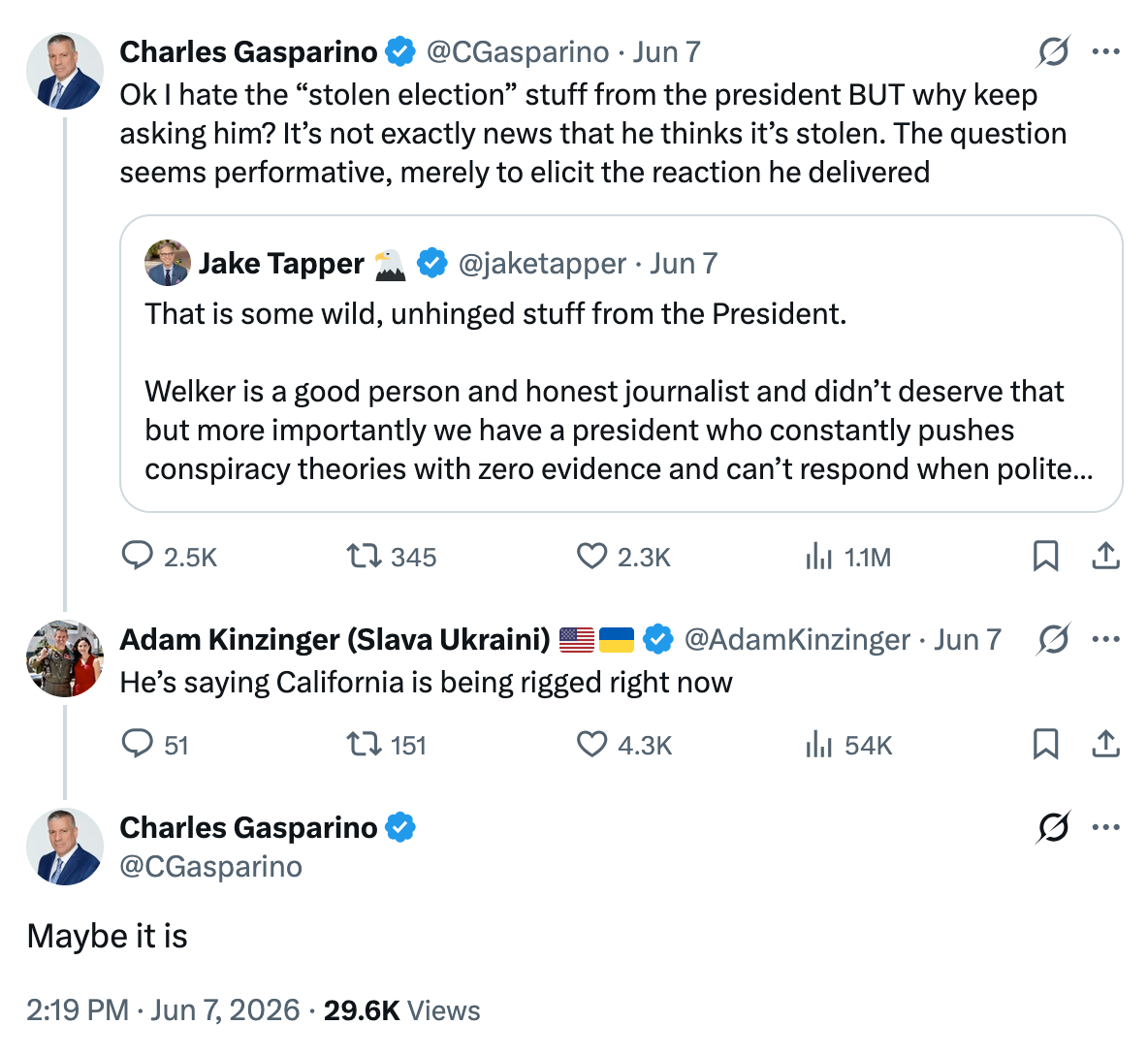
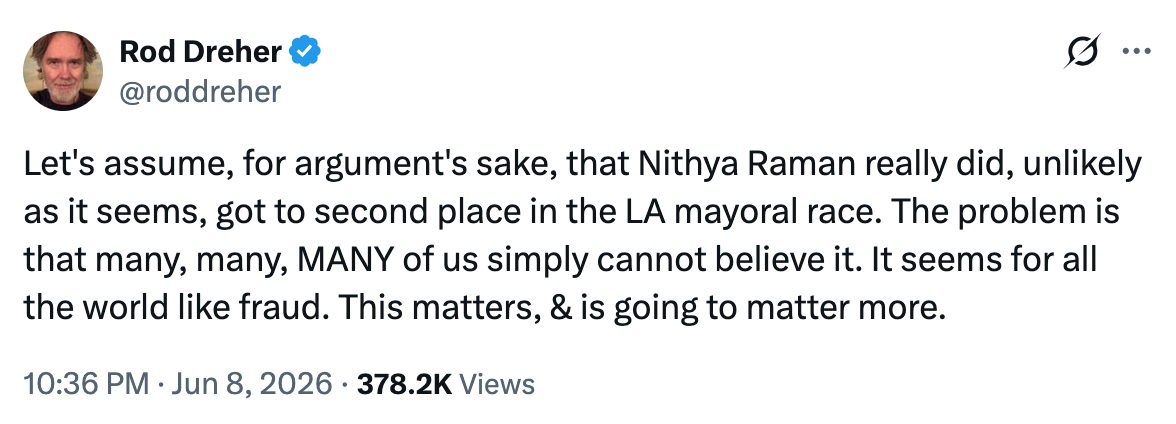
Republicans will never lose another election for the foreseeable future. To be more specific, they will never admit defeat. Largely inspired by the President, election denial has become a tentpole of Republican party politics. Trump himself has never conceded that he fairly lost the 2020 election and 63% of Republican voters agree that it was stolen. Refusal to accept the fair results of unfavorable political outcomes have metastasized throughout Republican politics to the state and local levels. Los Angeles mayoral candidate Spencer Pratt accused his opponent Nithya Raman of “finding votes” as she edged past him while mail-in ballots were being counted. When asked to provide evidence that the election is rigged, Republican Speaker Mike Johnson replied, “these efforts are so diabolical and so far upstream it's impossible to prove. But I think everybody knows instinctively that something is wrong here.” The right-wing Twitter consensus that the LA mayoral race is rigged is so pervasive that it’s infected the minds of Republicans that were previously doubtful of election denial conspiracies.

Everything Is Glonzo Now
Charles Gasparino (Fox Business) opining on a recent NBC interview in which the President falsely claimed the LA race was “rigged” before storming off set

Conspiratorial thinking is perhaps the most corrosive force that the Republican Party has unleashed on politics; an addictive cognitive drug that eventually consumes all rational thought. Much like a drug addiction, the more you feed a conspiracy theory the more powerful it gets. Each new data point in the conspiracy reinforces the rest and makes it harder to dislodge. Eventually it grows so large and multifaceted that any new data point can fit somewhere, including falsification of the conspiracy itself.

Everything Is Glonzo Now
Rod Dreher entertaining the hypothetical possibility that a Democrat got more votes than a Republican in Los Angeles

The digital age has ushered in a sort of golden age for conspiracy theories. Social media provided global platforms for crank theorists whose low-effort high-engagement thinking perfectly aligned with content algorithms. Cross-contamination and political incentives has led to a kind of convergent evolution for what used to be idiosyncratic conspiracists, a “great crank alignment” if you will. Making matters worse, while conspiracies grow more elaborate at political extremes, their style of thinking creeps inwards and takes up a growing share of political discourse. The damage of conspiracism is twofold: time and effort is wasted on combating the conspiracy theory itself and at the same time conspiracy theorists wreak havoc attempting to solve their nonexistent problems. Right now Republicans have a clear advantage when it comes to indulging in conspiracism for political engagement. Yet while I am not one for unilateral disarmament on the Democratic side—especially considering the fact that the Trump administration really is engaging in genuine criminal conspiracies—liberals need to exercise extreme caution before attempting to fight fire with fire.

Trump didn’t start the fire

Democratic voters are by no means immune to lazy or conspiratorial thinking, but the extent to which the Republican party has normalized and amplified conspiracy theories and theorists is without comparison. The Trump-era GOP has brought believers in QAnon, Pizzagate, weather machines, space lasers, chem trails, "9/11 was an inside job," and much more to the highest levels of political office in the country. EPA Administrator Lee Zeldin has stated in official press releases that “Americans have legitimate questions about contrails and geoengineering, and they deserve straight answers.” Robert F. Kennedy Jr. became the Secretary of Health after being personally implicated in worsening a Samoan measles outbreak that killed 83 people by helping to spread anti-vaccine conspiracies. Former Representative Marjorie Taylor Greene claimed that 2018 wildfires in California could have been caused by a solar-powered laser beam from spacecontrolled by, of course, the Rothschilds. The President himself is the architect of an election denial campaign that resulted in an insurrection at the Capitol that successfully delayed the certification of a Presidential election for the first time in American history. 

This tendency for conspiracization did not begin in 2016; it’s been a facet of mainstream Republican politics for as long as I’ve been alive. Right-wing media outlets indulged and enabled racist speculation regarding President Obama’s birthplace and religious beliefs for years—including from future President Trump. These speculations were so widespread and long-lasting that they played a role in both of President Obama’s election campaigns. During a 2008 town hall an audience member raised concerns that then-Senator Obama was “an Arab” and John McCain had to speak over a booing crowd to reassure them that “Obama is a decent person.” Four years later Mitt Romney indulged these racist speculations when he told a rally crowd, “no one’s ever asked to see my birth certificate … They know that this is the place that we were born and raised.”

The difference between McCain rejecting his voters’ conspiracism and Romney later indulging it serves as an omen for how Republican politicians would not just abandon their role as gatekeepers but actively encourage conspiracism in the American public. In 2015, the US military engaged in a training exercise named “Jade Helm 15” in the southern United States designed for practice among civilian populations. Right-wing conspiracy theorists ran wild, convinced that the exercise was a cover story for the imminent onset of martial law. Alex Jones speculated that “Helm” stood for Homeland Eradication of Local Militants. Elected Republicans’ response was not to calm the public and dismiss these insane theories: instead, Governor Abbott mobilized the Texas State Guard to “monitor” the exercise. Ron Paul applauded Abbott for “sympathizing with people who have great concerns with federal takeovers.”

One could argue that the Bush administration’s campaign to justify the Iraq War was in essence a conspiracy theory created and propagated by the federal government. In 2006, Jonathan Stein and Tim Dickinson published a timeline for how the United States ended up invading Iraq that documents much of the evidence cited by the White House, its flaws, and how administration officials played fast and loose with the facts, warping them into whatever suited their narrative. The desperate search for justification to depose Saddam Hussein used the same conclusion-first thinking that defines conspiracism.

It was all about finding a way to do it. The president saying, ‘Go find me a way to do this.'

—Treasury Secretary Paul O’Neill, recalling Bush’s first national security meeting

On September 12th, 2001, Richard Clarke (then National Coordinator for Security, Infrastructure Protection, and Counter-terrorism) remembered, “[Bush] told us, ‘I want you, as soon as you can, to go back over everything, everything. See if Saddam did this.'” According to Clarke, Bush asked for “any shred” of evidence Saddam was involved. On September 21st the intelligence community informed Bush there was no evidence linking Saddam to the 9/11 attacks. The next month Secretary of Defense Donald Rumsfeld formed his own intelligence group to search for evidence linking Saddam to terrorism.

US scrambling to establish a link between Iraq and Al Qaida is so far frankly unconvincing … It sounds like a grudge between Bush and Saddam.

There has been no credible evidence to link Iraq with Al Qaida.

—Downing Street memos (March 2002)
You can’t distinguish between Al Qaeda and Saddam when you talk about the war on terror.

—President Bush (September 2002)

In April 2001, months before the 9/11 attacks, a CIA analyst told the Bush administration that Iraq had purchased a large number of aluminum tubes that could only be used for nuclear centrifuges. In August the Energy Department (the agency tasked with American nuclear energy and weapons) rejected this theory in a memo to the CIA. In March 2002 Ambassador Joseph Wilson informed the CIA that based on his investigation there is no indication that Iraq is buying yellowcake uranium. French officials concurred in typical French fashion: “We told the Americans, ‘Bullshit. It doesn’t make any sense.'”

Almost exactly one year after 9/11 the New York Times ran a front-page story citing a White House official claiming Iraq had purchased aluminum tubes specifically for enriching uranium. That same day President Bush cited a non-existent IAEA report that Iraq was six months from developing a nuclear weapon, National Security Advisor Condoleezza Rice repeated the aluminum tube theory on CNN, and Vice President Dick Cheney lied on NBC, stating, “we do know, with absolute certainty, that he is using his procurement system to acquire the equipment he needs in order to enrich uranium to build a nuclear weapon.”

What strikes me about this timeline is how much it resembles President Trump’s election denial conspiracy theory, two decades later. One of the most damning excerpts from the January 6th Select Committee report is a series of instances in which Trump repeats claims that his own administration has previously told him are false, much like the aluminum tube theory being rejected by the Energy Department only to resurface a year later as “absolute certainty.”

“And so he said, ‘Well, what about this? I saw it on the videotape, somebody delivering a suitcase of ballots.’ And we said, ‘It wasn’t a suitcase. It was a bin. That’s what they use when they’re counting ballots. It’s benign.’” 


—Then-Deputy Attorney General Jeffrey Rosen (December 15, 2020)

“There is even security camera footage from Georgia that shows officials telling poll watchers to leave the room before pulling suitcases of ballots out from under the tables and continuing to count for hours.”


—Donald Trump (December 22, 2020)

“I told the President myself that several

times, in several conversations, that

these allegations about ballots being

smuggled in in a suitcase and run

through the machine several times, it

was not true, that we looked at it, we

looked at the video, we interviewed the

witnesses, that it was not true . . . . I

believe it was in the phone call on

December 27th. It was also in a meeting

in the Oval Office on December 31st.”


—Acting Deputy Attorney General Richard Donoghue (December 27 & 31, 2020)

“[S]he stuffed the machine. She stuffed the ballot. Each ballot went three times, they were showing: Here’s ballot number one. Here it is a second time, third time, next ballot.”


—Donald Trump (January 2, 2020)

“Then he raised the ‘big vote dump,’ as he called it, in Detroit. And, you know, he said, people saw boxes coming into the counting station at all hours of the morning and so forth … I said, ‘Mr. President, there are 630 precincts in Detroit, and unlike elsewhere in the State, they centralize the counting process, so they’re not counted in each precinct, they’re moved to counting stations, and so the normal process would involve boxes coming in at all different hours.’ … I mean, there’s no indication of fraud in Detroit.’”


—Attorney General William Barr (December 1, 2020)

“I’ll tell you what’s wrong, voter fraud. Here’s an example. This is Michigan. At 6:31 in the morning, a vote dump of 149,772 votes came in unexpectedly. We were winning by a lot. That batch was received in horror … In Detroit everybody saw the tremendous conflict … there were more votes than there were voters.”


—Donald Trump (December 2, 2020)

Conspiracy theories and the lies they rely on are an addiction. When your conclusion is set in stone and you treat evidence as a tool to get there, each lie begets another. Reality is internally consistent, so to appear truthful a conspiracy theorist must continue to repeat the same lies over and over again. Donald Trump is without a doubt the biggest liar to ever sit in the Oval Office, but Republicans have been practicing for decades.

No reliable information on whether Iraq is producing and stockpiling chemical weapons.

Defense Intelligence Agency assessment (September 26, 2002)
The Iraqi regime possesses biological and chemical weapons, is rebuilding the facilities to make more, and, according to the British government, could launch a biological or chemical attack in as little as 45 minutes after the order is given.

President Bush (September 28, 2002)
While a small number of old, abandoned chemical munitions have been discovered, ISG judges that Iraq unilaterally destroyed its undeclared chemical weapons stockpile in 1991. There are no credible indications that Baghdad resumed production of chemical munitions thereafter.

Charles Duelfer, Comprehensive Report of the Special Advisor to the DCI on Iraq’s WMD (April 25, 2005)

Brainworms are contagious

Even with the Republican Party’s many years of practice, conspiracism is not a uniquely right-wing phenomenon. Left-flavored populism has the same tendency towards oversimplified narratives and scapegoating a vague, shadowy elite. Right-wing crazies think the source of all evil is globalists, “the Cathedral,” or the Jews while left-wing crazies think it’s billionaires, “Wall Street,” or Israel. The conspiratorial mindset takes the fact that there are evil billionaires (see: Elon Musk) or evil Jews (see: Jeffrey Epstein) and extrapolates it in both directions, attributing every problem to an abstracted concept of the villain. This two-step is what makes conspiracism so corrosive to public discourse. It hijacks good-faith actors discussing genuine problems as vessels to spread a bad-faith worldview that inherently cannot solve real problems.

The most relevant and timely example of left-wing conspiracism can be found in the simultaneous rise in anti-Israel and antisemitic sentiment since the October 7th attacks and subsequent ethnic cleansing in Gaza. Opposition to Israel bleeding into antisemitism is not a new phenomenon on the far left—the initial reaction for some to October 7th speaks for itself—but as the opposition to Israel grows, so too does antisemitism in proportion. The double-edged sword of conspiracism is found in both the direct harms of antisemitism as well as in poisoning the well for otherwise legitimate criticism of Israel.

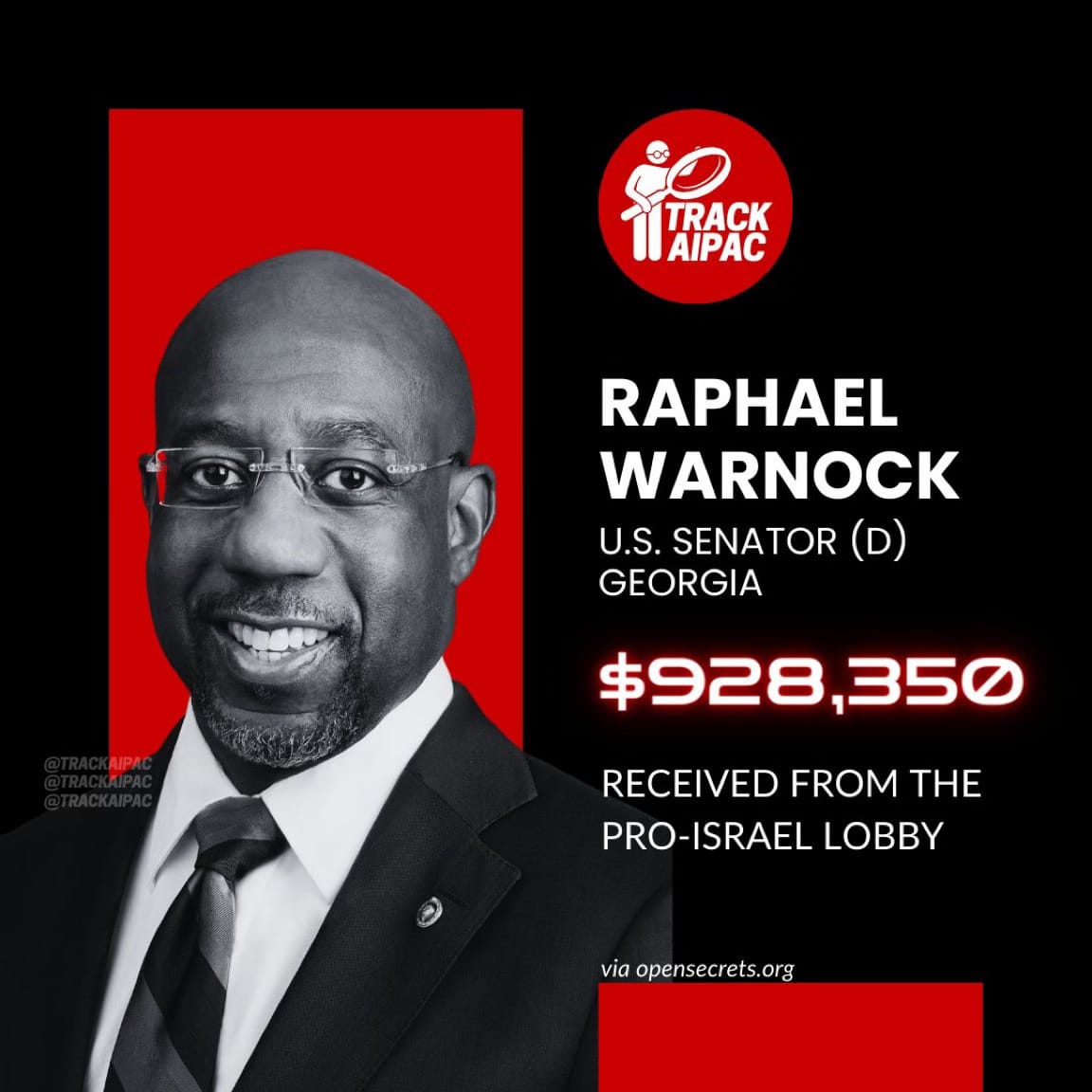
A focal point for rising anti-Israel sentiment within Democratic politics has been heightened scrutiny and criticism of AIPAC (the American Israel Public Affairs Committee) and the candidates who accept their support. Disliking AIPAC and the causes they stand for is not inherently conspiratorial or antisemitic. A voter who opposes the actions of the Israeli government has every reason to oppose a political advocacy group that supports the actions of the Israeli government. The problem is when “AIPAC” stops referring to the actual real-world AIPAC and instead refers to an imaginary version made to play the role of a conspiratorial villain. Take, for instance, the group “Track AIPAC” whose infographics have become instantly recognizable on social media. The account purports itself to track how much money political candidates have accepted from AIPAC, dressing the number up in a scary red or bright green background depending on the result. There’s just one small issue: Track AIPAC doesn’t actually track AIPAC.

Everything Is Glonzo Now

This Track AIPAC graphic from yesteryear claims that Georgia Senator Raphael Warnock received $928,350 from the “pro-Israel lobby.” But according to FEC data, Senator Warnock received no such donations from AIPAC. He’s not even listed on AIPAC’s website as an endorsed candidate. What Track AIPAC actually tracks appears to be contributions from any Israel-related group (such as the much less militantly pro-Israel J Street) as well as any individual donors who have themselves donated to Israel-related groups (see Christopher Webb for more). After people criticized Track AIPAC for the misleading information, they “updated” their graphics to supposedly show more detail. It’s not much of an improvement, simply splitting the total into two similarly opaque “PAC” and “Individual” categories.

Such an obfuscated and dishonest methodology lends itself to worse impulses than just exaggerated numbers. Take the case of Senator Chris Van Hollen and House candidate Daniel Biss, neither of whom have taken AIPAC contributions. Van Hollen got the green background and $0.00 while Biss got a red background and $460,357. This is bizarre considering Biss is a vocal critic of AIPAC and according to him the organization spent millions on his opponent. So why does he get the harsh treatment compared to Van Hollen? Maybe it’s the fact that Daniel Biss is Jewish.

Everything Is Glonzo Now

Everything Is Glonzo Now

Track AIPAC is mostly an online phenomenon—the graphics are designed to be used on social media for quote-dunks and ratios—but its conspiratorial style of politics has unfortunately found purchase in more professional spaces. Mehdi Hasan, formerly of MSNBC, hosted the pair behind Track AIPAC (Cory Archibald and Casey Kennedy) for an interview with his own media company Zeteo. The interview is titled “Meet AIPAC’s Nightmare” and is far from the hostile interrogations that Mehdi Hasan is well known for. In the blurb attached to their interview, Hasan describes the two as “the brains and brawn behind the effort to bring transparency back to US elections” and says that the project “names and shames US politicians on AIPAC’s payroll.” This could be a careless oversight, but considering Zeteo just recently published a very questionable article on the USS Liberty incident (a long-standing conspiracy theory that Israel intentionally attacked a US vessel) I don’t think they should get the benefit of the doubt.

Educational polarization provides some protection against conspiracism—it’s harder to do well in school if you believe in chemtrails and a flat earth—but sometimes it just means the conspiracy theories need to sound a little bit more believable. Opposition to the AI-driven data center construction spree has rapidly grown among Democratic voters, including support for an outright ban on new projects. Many arguments against data centers (or AI more broadly) are based on false claims regarding heat output or water usage. Up north in the current hotseat for left-wing slopulism—Graham Platner’s state of Maine—nearly half of Democratic voters think Kamala Harris was the legitimate winner of the 2024 election according to a May poll. The fact that election denial has essentially zero purchase among elected Democrats merely speaks to how much better Democratic politicians are at gatekeeping this side of the aisle’s latent conspiracism.

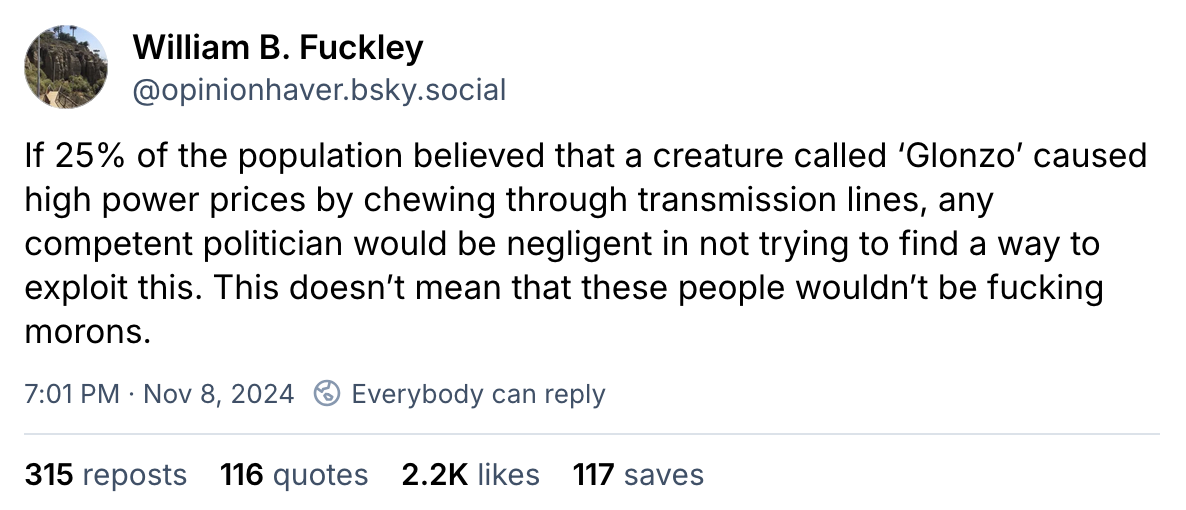
There is a certain Bluesky post that has entered the personal lexicon of me and many other terminally online liberals. I speak, of course, of Glonzo.

Everything Is Glonzo Now

The original post was made in the midst of a social media driven panic regarding drone sightings in New Jersey, but now “Glonzo” serves as shorthand for falsehoods that have widespread public belief. Thinking AI is using up all the water is Glonzo. Thinking immigrants are stealing all the good jobs is Glonzo. Thinking we can easily save trillions of dollars by cutting “waste, fraud, and abuse” from the federal budget is Glonzo. Donald Trump’s victory in 2024 on a campaign constructed entirely out of Glonzo issues (e.g. mass deportations will solve the housing crisis) left many liberals reeling. Some decided in the wake of this success to harness Glonzo for good. If the public is going to be stupid then at least point their stupidity at the bad guys. Perhaps the biggest example of this is the ongoing Epstein saga, though this is somewhat of a special case in that it has a genuine kernel of truth at its core (more on this later).

Populism and conspiracism are not quite synonymous but they are inextricably linked. The essence of populist rhetoric is positioning you, the common man, against a nefarious and powerful elite that is to blame for your problems. It’s not hard to see how one leads to the other. Populism is not a foreign language to the left—anybody with an interest in politics can easily imagine Bernie Sanders reciting his trademark “the one-percent” stump speech—but a rising tide raises all ships and Donald Trump remaking the GOP in his MAGA image has spurred the rise of new populists on the left and motivated some established politicians to lean in.

My caution to those eager to embrace the dark side is a reminder that lying is addictive and effective governance requires an accurate view of the world. Donald Trump’s presidency is awful not just because it has turned the most powerful nation in history into a vehicle for pointless cruelty. It also fails on its own merits because they’ve drunk too much Kool-Aid. MAGA genuinely thought turbocharged tariffs would lead to a resurgence in American manufacturing when basic economics would have told them it would do the opposite. They really did believe the only failure of America’s previous Middle Eastern wars was woke liberals not blowing the bad guys up hard enough. What happens if you run a political campaign promising to hunt down Glonzo to lower people’s power bills and win? Everyone’s power bills will stay the same and in four years you’re gonna lose to the guy who accuses you of being on GPAC’s payroll. What sets good leaders apart from bad is the ability to appeal to voters’ impulses on the campaign trail without succumbing to them while in office. To see the difference between riding the populist wave and getting dragged under, look no further than someone living long enough to see themselves become the villain.

Ned Resnikoff, author of the upcoming Build or Die, wrote a great piece on Senator Elizabeth Warren and her recent downfall as the resident progressive policy wonk in Congress. I’m not exactly in the same boat as Ned—he recalls being in the audience for a conference speech by Warren in 2015 that I didn’t attend because I was too busy playing Destiny: The Taken King after school—but I resonate a lot with how he held Senator Warren in high regard for her attention to policy details. As he notes, an unofficial campaign slogan for her 2020 Presidential run was “I have a plan for that.” It is this reputation as a “bona fide serious person” that makes the Massachusetts Senator’s recent missteps that much more disappointing. 

The first sign of trouble for me was when she endorsed a plan President Trump floated about capping credit card interest rates, going so far as to publish a Fox News opinion piece criticizing Trump when the plan never materialized. Then came the ROAD to Housing Act, a legislative package co-sponsored by Senator Warren ostensibly designed to ease the nation’s housing shortage. Buried within the bill was a provision that reeked of slopulism: banning individuals or firms from owning more than 350 single-family houses. A popular Glonzo issue is the idea that a significant driver of high housing costs is large Wall Street investment firms (e.g. BlackRock, though technically it’s a different firm named Blackstone that invests in housing) buying up a large number of houses to speculate on their value. In reality, big investors own a tiny fraction of housing stock—0.59% according to this analysis—and the houses that they do own are mostly used as rental properties, not sitting vacant. While it’s true that Wall Street investors do not own any meaningful share of existing housing stock, the language of this bill essentially outlaws large firms from building new rental housing at scale. Thus a pointless regulation targeting 0.59% of the housing market could cripple a much larger share of new housing construction. According to estimates by real-estate firms, the build-to-rent sector built as many as 70,000 to 130,000 new homes in 2024. Senator Warren not only co-sponsored the bill but specifically supported this provision. Her argument for such can be found on the Senate Banking, Housing, and Urban Affairs Committee website:

Allowing private equity firms and other large institutional investors to snatch up thousands of homes can make it impossible for individuals and families to buy their own home … This is extremely popular with the American people: 64% of Americans support reining in corporate landlords and institutional investors to lower housing costs and 73% support banning corporate investors from single-family homes … Institutional investors have the resources to outbid families and have taken hundreds or thousands of single-family homes off the market.

This is pure, uncut, black-tar slopulism injected straight into the vein. Investors owning less than one percent of housing is not the reason why any American families struggle to afford a home. Rental houses are not “off the market.” Imagine the absurdity of demanding a ban on owning more than 350 cars and thus destroying the rental car industry because they’re “taking vehicles off the road that American families deserve to drive.” It’s total nonsense. Indulging this kind of rhetoric on the campaign trail is one thing, but implementing it as actual legislative policy is malpractice. Nobody benefits from this. Homeownership will not magically increase just because we’ve outlawed the rental market. In reality many large firms will simply stop building new rental homes and everyone will be left worse off. In perhaps the biggest irony, there is economic research showing that investors buying into the single-family housing rental market can serve to decrease racial segregation and socioeconomic inequality by lowering the barrier of entry into rich neighborhoods—results that would normally be progressive policy goals. So much for the progressive policy wonk.

Indulging in slopulism also makes it easier for worse figures to rise. Elizabeth Warren was one of the first national Democrats to endorse Graham Platner in his primary campaign, describing him as “the real deal” and “a fighter [who’s] ready to take that fight to Washington.” Platner—who bears a slight resemblance to Bane in his Kik profile picture—has not merely adopted the slopulism but was born in it, molded by it. Even if it weren’t for his taste in 1940s German tattoo art or concerning history with women, the man’s politics are completely without substance. Every tweet I’ve read, speech I’ve heard, every commercial I’ve seen is just anti-establishment angst pointed in no clear direction with no clear purpose and no clear goals. Sure I would rather him sit in Congress than Susan Collins, but his brand of politics is not one that should be encouraged or amplified.

The future of Democratic politics should ideally include fewer candidates who run TV ads that open with “some of the most powerful Democrats and Republicans in the country were on Epstein Island … it seems the only thing the party establishments can agree on is a love of Jeffrey Epstein.” 

The boy who cried wolf was right

Yet the problem with trying to avoid conspiratorial thinking in the Trump era is the fact that he has made many conspiracy theories come true. The President, his Cabinet, military officers, and many members of Congress are, strictly speaking, engaging in dozens of criminal conspiracies. Donald Trump and his cronies have discovered a clever loophole where if you do enough crimes in public then a lot of people stop perceiving them as crimes (including the Supreme Court of the United States). It’s a bizarro-world inversion of the cover-up being worse than the crime, an adage coined to describe the Watergate scandal. Turns out if Nixon just went on TV and said, “yeah I paid some guys to break into the hotel to spy on those crooked Democrats, what of it?” nobody would have cared.

When I see polling results among Democratic voters showing that shockingly high numbers of people believe the assassination attempts on Trump were staged or that Kamala Harris really won the 2024 election, part of me wonders if I can really blame them. When you consider the objectively true list of things that Donald Trump has done in the past, is doing right now, or has openly bragged about wanting to do in the future, is it really that much of a stretch? Off the top of my head I can name at least a half-dozen stories that would sound schizophrenic if they weren’t our current reality.

Worst of all, the most damaging conspiracy theory in modern American history is actually true. There really was an attempt to illegally change the results of the 2020 election. It was carried out by Donald Trump. 

Following his loss on election night, the President of the United States pressured state officials to change their results, filed over sixty lawsuits across the country seeking to obstruct or overturn vote counts, coordinated across seven states (Arizona, Georgia, Michigan, Nevada, New Mexico, Pennsylvania, and Wisconsin) to submit fraudulent Electoral College votes to Congress, organized a mob of thousands and ordered them to march on the Capitol building, then as the violent mob broke into the Capitol building attempted to coerce lawmakers and the Vice President into accepting his fraudulent votes. All of this is objective fact, meticulously documented in a public Congressional report. It’s not beyond belief that Trump might have tried to rig the 2024 election—or for that matter that he might try to rig 2026 or 2028—because he already tried once before

And so I feel trapped in this three-pronged dilemma. On one hand I understand that I am not the typical voter. If any politician ran a campaign that perfectly appealed to me in style and substance they would probably end up with negative votes. On the other hand leaning into populism or conspiracism is playing with fire and runs the risk of sabotaging one’s ability to govern. Then on the other-other hand it’s literally true that there are evil billionaires (and now one trillionaire) manipulating the government to enrich themselves and commit heinous crimes.

Ryan Geddie has a pair of video essays that heightened a lot of this tension for me. The first (Ezra Klein and What Happened to American Liberals?) addresses many of my problems with the current liberal pundit class: the liberal consensus established in the wake of the Cold War was taken for granted and too many forgot how to fight for liberalism against illiberal opponents, sometimes living in denial that illiberal opponents even exist. The second (Liberal Populism is The Future of the Democratic Party) gave me a kneejerk reaction from the title alone. This was my vision of the bad ending: the future of American politics descending into fascism versus slopulism. Swallowing my pride and watching more, Geddie points out some things I’m missing that maybe, just maybe, could point to a better way forwards.

The opening line, “for a certain kind of liberal the worst thing you can be in the whole world is a populist” is spot-on, almost like he was spying over my shoulder while I was writing this. He goes on to argue that because populism is not itself a political ideology but a style of political rhetoric, there is no inherent reason why liberalism must exist in separation or opposition from populism. This stands opposed to the framework of many prominent liberals today, such as Derek Thompson, who is quoted in the video remarking, “I am not a populist, I am a liberal” (which admittedly sounds a lot like something I would say). But Geddie points to several historical liberal figures—some of whom defined liberalism for their generations—who made populist appeals in service of their liberal ideology. Thomas Paine wrote in Common Sense “of more worth is one honest man to society than all the crowned ruffians who ever lived.” A century and a half later FDR both sold his New Deal agenda with populist rhetoric and successfully led the country through its greatest crisis since the Civil War. It cannot be the case that populism is inherently incompatible with liberal government. Maybe the problem isn’t that populism is illiberal. Maybe the problem is that we forgot how to make liberalism popular.

Later in the video Geddie plays another clip of Derek Thompson where he dismisses the need for liberals to put forth a political narrative: “stories are for children,” he jokes. I find myself stuck in cognitive dissonance. Thompson is arguing against something I despise, populism, with an argument that encapsulates the fatal flaw of modern liberalism. You cannot, as Thompson puts it, “just have a plan to make people’s lives better” when the debate is over what makes a life better. This is what debate nerds like me refer to as begging the question. A detailed policy plan to provide more efficient government services has nothing to offer against opponents who reject the idea that the government should serve the people. Our political battles right now are not over the best ways to spend government money, but whether a President should withhold government money from states that don’t vote for him. When Stephen Miller claims that immigrants are a drain on the economy it does not matter that he is incorrect. Stephen Miller doesn’t care about the economy, he cares about lowering the number of non-white Americans by any means necessary. Whatever comes after this administration cannot be limited to a bullet-pointed list of policy ideas, regardless of how good those ideas are. The debate is not about what government should do, a question perhaps answered by something like “Project 2029”; it is a debate about what government should be, a question answered by something more like the Reconstruction Papers. It’s for this reason I was drawn to Liberal Currents and motivated to write here. They understand the stakes.

If it is indeed the case that successful liberal populism can exist, then where is it? Geddie puts forth the not-yet-official but almost certain-to-be Presidential candidate Jon Ossoff as an example. As the first national politician I’m aware of to use the term “Epstein class,” the Senator from Georgia is definitely engaging in populism, so much so that my spider-senses start tingling. Is the term “Epstein class” inherently antisemitic? Doubtful coming from a Jewish Senator, but almost certainly coming from others. Is it inherently conspiratorial? Yes, but then again Jeffrey Epstein genuinely did orchestrate a criminal conspiracy and he really was friends with a lot of powerful people. Obviously Ossoff does not set off the same red flags that someone like Platner does when he references “corrupt elites,” but even a seasoned veteran like Elizabeth Warren fell victim to a wild Glonzo chase. Geddie acknowledges Ossoff’s strong populist bent, even playing a clip of the aforementioned “Epstein class” line, but argues that it is paired with a strong sense of liberal principles evidenced by a later segment from that same speech:

I listened to a speech a few months back by a Senator from Missouri who’s aligned with the President. What I think I heard him say was that the only real Americans are those descended from the original European settlers. Now maybe he forgot the Mayflower itself was full of religious exiles fleeing persecution, but our heritage isn’t limited to that of the pilgrims and those who settled the West. America’s heritage includes descendants of slaves who won liberation from slavery and Jim Crow. It includes the Creek Indians who lived in middle Georgia for eleven centuries straight. It includes immigrants from every region and continent who arrived here fleeing persecution or seeking opportunity. Americans are not a race. We’re a people … That is what makes us exceptional.

This is the strongest and most direct refutation I have seen of the “heritage American” narrative from a politician on the national stage. It is not an argument for immigration on its merits as policy but for its own sake as something essentially American. That is the real debate that American liberals need to be capable of fighting and winning, not how to best achieve “abundance” or “affordability” or whatever new buzzword surfaces by 2028. My concern is whether or not people see much of a difference between someone like Ossoff and someone like Platner if they're both giving speeches about the corrupt Epstein class. The next Democratic administration already has an immense amount of work cut out for them. They cannot afford to waste any time or effort chasing after Glonzo. 

Populist rhetoric and the conspiracism it breeds is dangerous; Democrats should look before they embrace the public’s latest bugbear. Indulging exaggerated narratives and false beliefs on the campaign trail can spell self-sabotage when the time comes to make actual policy. At the same time there are very real conspiracies afoot that cannot be defeated with merely a good enough tax code or the right set of regulations. There can be no return to normalcy unless a lot of rich and powerful people spend the rest of their lives in federal prison. Elections cannot be won on policy platforms and think tank papers. Liberals need to foster and embrace a popular vision of what it means to be American, what America should look like, and what the purpose of a government even is in the first place. Not only is this needed to win the public’s faith in 2028, it is a necessary compass for the new government to follow in its reconstruction. I just don't think screaming “Epstein class” is the way to get there.


Featured image is " 9/11 Was an Inside Job," CC BY 2.0 911conspiracy.

Read the whole story
jsled
41 days ago
reply
South Burlington, Vermont
Share this story
Delete

Triple Shockwave from Sun Crossing Rocket

1 Share
The disk of the Sun is shown with a rocket launching
through it. The rising rocket shows a plume behind it and
three unusual waves curve around its top tip.
Please see the explanation for more detailed information.
Explanation: What's happening to this Sun-crossing rocket? The SpaceX Falcon 9 rocket, visible on the upper left, launched only about one minute before this amazing image was captured. As it rose to low Earth orbit from Cape Canaveral, Florida, USA, in late May, the rocket became supersonic before it crossed the disk of the distant Sun -- from the perspective of the well-placed photographer. The spacecraft's high speed caused bow-shaped compressed-air shockwaves to form across leading surfaces, with at least three visible even outside the Sun's disk because they refract sunlight. The trailing exhaust caused turbulence visible on the lower right. None of this was damaging to the robotic Starlink 10-53 mission, which delivered 29 communications satellites to low Earth orbit as planned. And if that isn't amazing enough - the Sun had spots!
Read the whole story
jsled
43 days ago
reply
South Burlington, Vermont
Share this story
Delete
Next Page of Stories